Overview
Staying current in UX design is an ongoing challenge as our tools, methods and strategies evolve daily. The subreddit r/UXDesign is a place where working designers actually share candidly and openly. Portfolio reviews, salary negotiation, layoffs, project rescues and the love / hate relationship with AI. The signal is high. But, it's A LOT.
This isn't just my problem. Reddit users across the site describe the same pattern in their own words: too much content, endless scroll, weak feed control and FOMO. I wanted to keep the strong signal and drop the high effort.
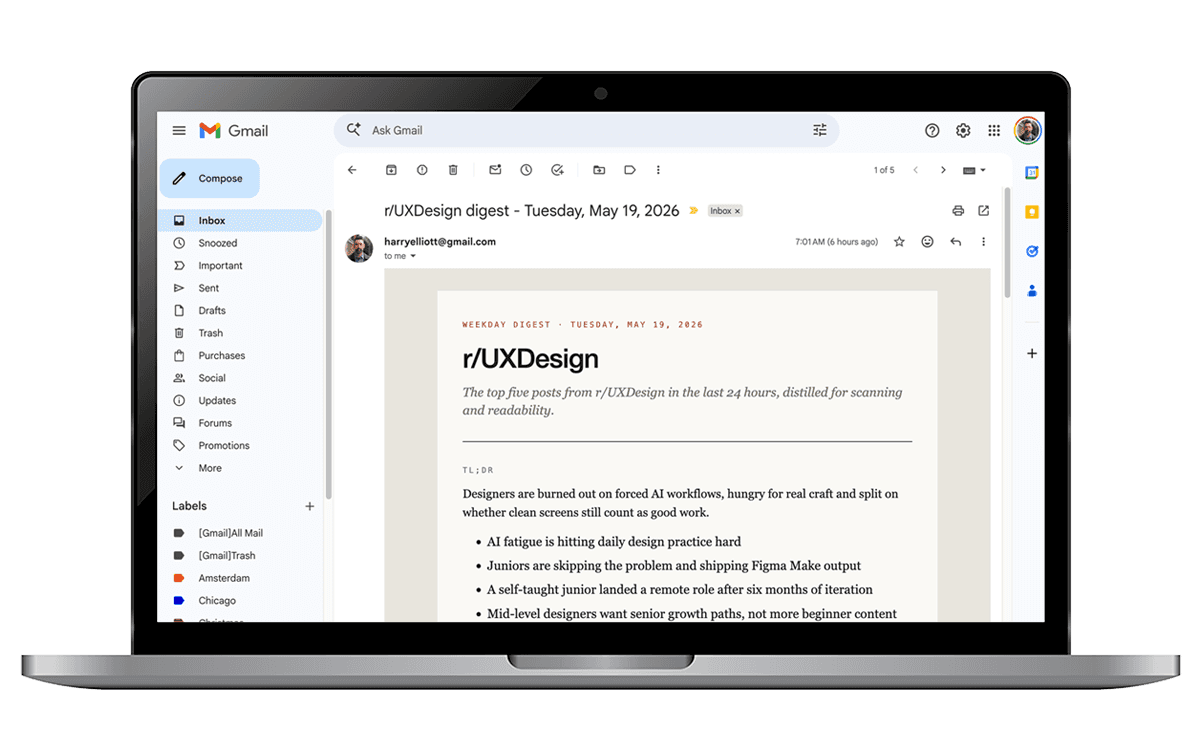
So I created a Weekday Digest that lands in my inbox each weekday morning at 7 a.m. Top posts from r/UXDesign over the previous 24 hours come in as a single email, summarized by Claude, formatted for the constraints of the inbox. No app to open. No doomscroll. The whole intake takes about three minutes. If an important topic grabs my attention, it's one click to dive into the full thread.
The digest is a working artifact, not a mockup. It ships every weekday and I refine it regularly. It's also a piece of evidence about how I work with AI as part of the actual craft.
My contribution
User Research / Workflow Design / Prompt Engineering / Email Design / Script Development
The team
Me, Myself and I
Process
The problem in Reddit users' own words
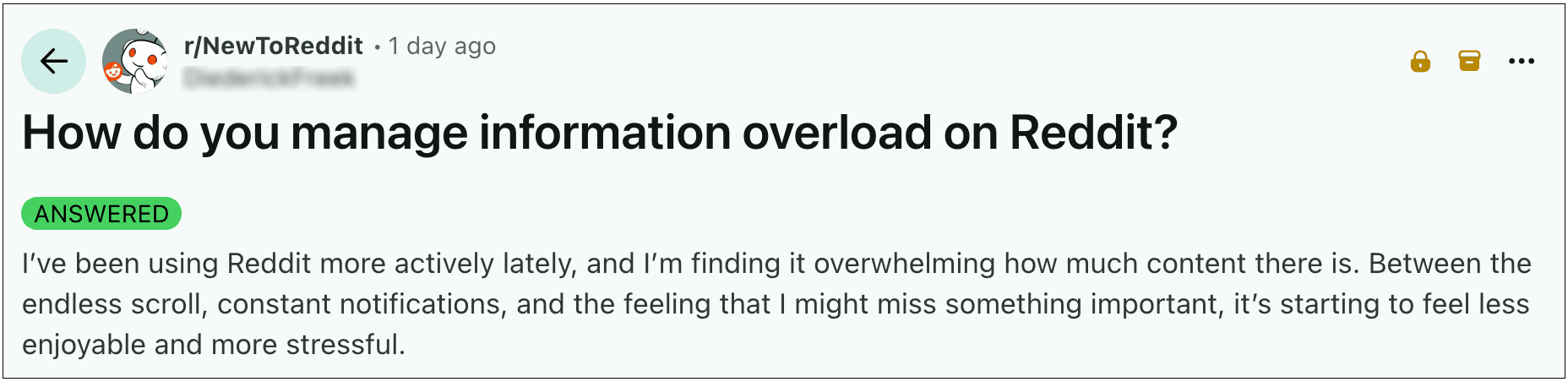
I checked my own frustration against what other Reddit users say. Posts in r/NewToReddit titled "How do you manage information overload on Reddit?" and "Absolutely lost" both use the phrase information overload. We all seem to have the same exhaustion from helpful threads buried under thousands of replies, arguments and side conversations.
Weekday Digest is my response to that problem, built for one subreddit but pointing to a much larger product opportunity.
Right-sized tooling decisions
I chose Claude Code over the Claude desktop app because the script and the schedule needed to live in the same place. I chose email over file output because email is where my morning attention already lives. I chose weekday-only because… weekend! Each decision was the simplest tool that would actually work and only added complexity when it earned its place.
A design system for the inbox
Email is a meaningfully harder design surface than a product UI. System fonts only. No flexbox in older clients. No hover states. No JavaScript. The digest's typographic system bent to those constraints without breaking. The post-title hierarchy, the source link treatment, the section breaks. All of them work within the limits older mail clients impose.
Right-sized AI
Claude does the synthesis. The script does the Reddit API calls, retry logic, styling and email delivery. The voice on top isn't Claude's. It's mine, filtered through a writing style guide I built. Voice profile, AP-style rules and writing samples load into Claude's context every morning before it touches a single Reddit post. The AI is one tool in a pipeline I wrote, not the headline.
A working artifact, not a mockup
It runs on my machine. It lands in my inbox at 7 a.m. each weekday. I refine the prompt and the style guide as the output reveals itself. Live, real-world artifacts always read as more credible than concepts. A case study that says "here's a Figma mockup of an idea" lands differently than one that says "here's what I read this morning."
Outcome
The digest is the way I now keep up with the design field. The 30 minutes a day I used to spend on Reddit is gone. The signal isn't. I trust the summarization because I wrote the prompts and the style guide that produces it.
The next phase is rolling the same pipeline out to other subreddits I care about. The architecture is the same: a script, a prompt, a style guide, an inbox. The public GitHub release will be the proof that the workflow is portable, not just personal.