Overview
AI-assisted content creation can fail silently. A fabricated quotation reads exactly like a real one and a false or "hallucinated" claim reads exactly like a true one. And the review by a human might not catch either. This project is a working answer: an intensely personalized "product" where every quotation is machine-verified against its printed source and every claim must name the book it came from before the document gets created.
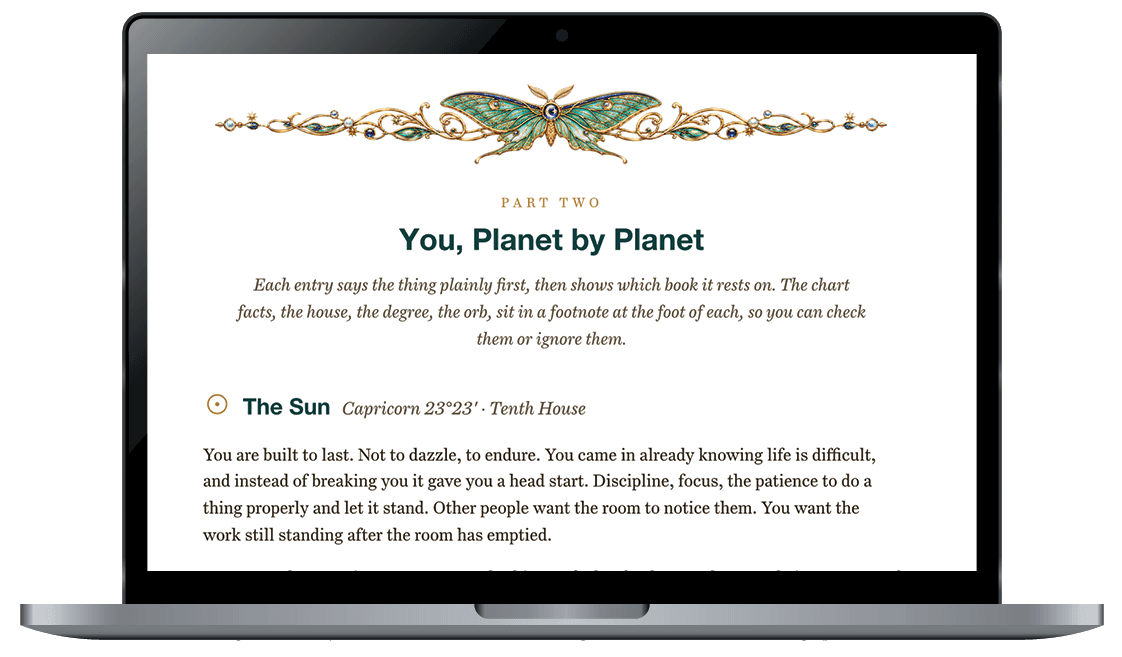
The subject is astrology and the deliverable is an illustrated natal chart reading of dozens of pages built for one person at a time. Believe in it or don't. Either way, nothing in it can be checked against the real world. The only available truth is provenance. So provenance is what I built the system to guarantee.
My contribution
UX Strategy / AI Orchestration / Editorial Governance / Art Direction / Design Systems / QA Automation
The team
Me / Myself / I
Process
Verification belongs in the pipeline, not in review
Reading for errors doesn't work when the errors read well. A fabricated citation is fluent by construction. Fluency is what a proofreader is scanning for. A document written for one person makes it worse, because there is no crowd. Mass content gets free quality assurance from its audience. An audience of one gets none.
So verification isn't a step at the end. It's a checkpoint in the middle. Twenty automated checks run before any document can print. Every quotation is matched word for word against the full text of the book it came from. A section that names no source fails the build. Nothing renders for delivery unless the strict pass returns zero warnings. The checker has its own regression test, 14 planted errors it has to catch before I trust it.
Drafts stay unchecked on purpose. A quality process that nags people at the wrong moment gets overridden and an overridden process is dead. Review doesn't scale. Systems do.
Generated art needs a design system too
Thirty plates: 12 signs, 10 planets, four chart points and four angles. One palette, one border language, one aspect ratio.
A script holds every plate to exact dimensions. It caught three that had come back a single pixel off spec, the kind of error that survives forever because nobody can see it.
Name the spec, enforce it mechanically and treat consistency as a trust signal rather than a preference.
Honesty as an interface decision
Two design decisions do the work a disclaimer would do badly.
Every reading opens by stating exactly what I was told about the person before I wrote it, which is usually their birth data and almost nothing else. A reading written by someone who knows your life is not evidence that astrology works. It's evidence the writer can cold-read.
And before anyone sees a word of their chart, they answer three questions about how they see themselves. The options come from their own chart's vocabulary, shuffled, with the sign names stripped out so they can't research their way to a flattering answer. Their answer prints beside the chart's. When the two disagree, the document says so and treats it as the most interesting page in it.
Without that structure the product is a mirror, flattering words beside a reading that confirms them. The blind sequence is what makes it honest. It's built into the experience instead of promised in a footnote.
Outcome
The astrology is the test bed. The method transfers to products where generated content has to be trusted:
Content backed by retrieval, where the citation has to be real
AI features that quote sources back to users
Generated assets that need a spec and governance
QA for output that has no single correct answer
I built this alone, start to finish. A reading goes from birth data to verified, print-ready PDF: intake, computation, research, writing, verification and print.